Postgres Extensions Day — See You There!

The annual PostgreSQL developer conference, PGConf.dev, will be held in Montreal in May. Postgres Extensions Day takes place the day before it, with a focus on extension development, packaging, and release. The agenda has just been released, with 14 talks.
This time, I’ll be speaking in the first afternoon session: “The Missing Postgres Extension Repo and Package Manager”. I’ll introduce Pigsty’s extension repository and the PIG package manager, and discuss the work of building and maintaining PostgreSQL extensions. It is a chance to share a Chinese developer and database vendor’s experience with developers from around the world — even if that vendor is a one-person shop, haha.
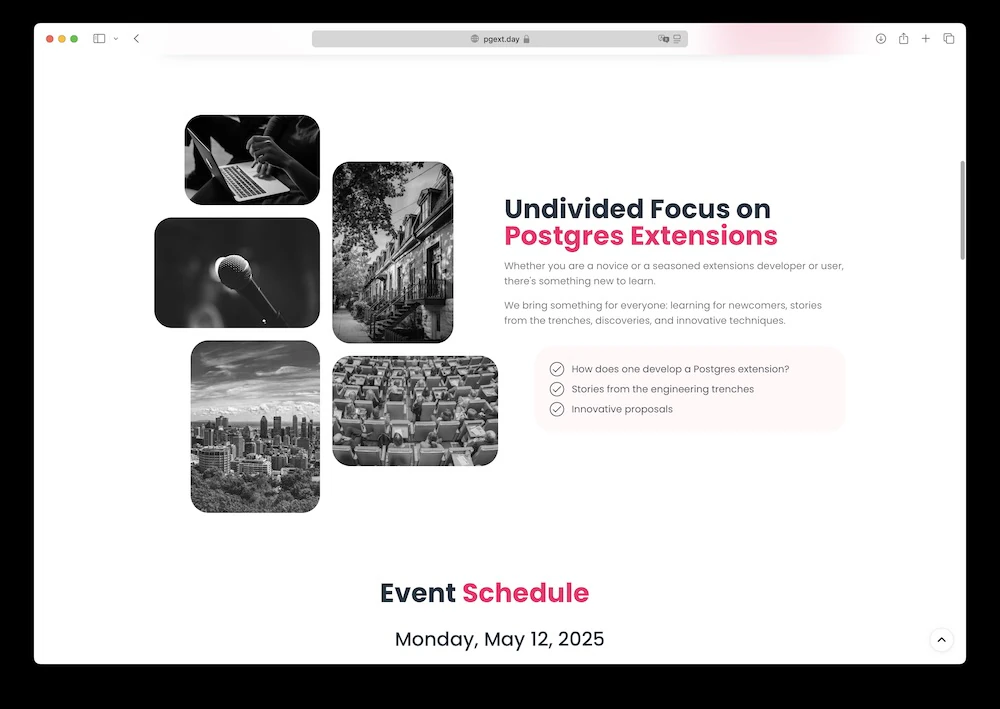
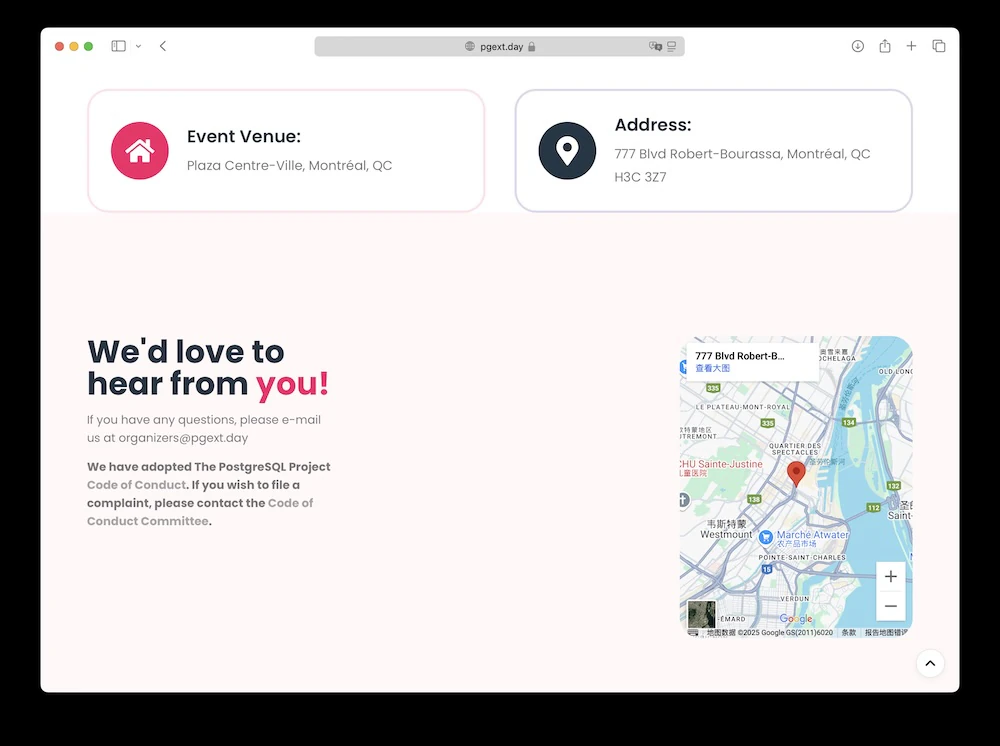
Postgres Extensions Day is scheduled for May 12, 2025, at Plaza Centre-Ville in Montreal, Quebec, Canada. PGConf.dev 2025 follows at the same venue on May 13–16.
Last year’s PG developer conference in Vancouver was incredibly rewarding, though there were very few participants from China. Not sure how this edition will be - if you’re also going, please leave a comment and we can meet up in person!
If you plan to attend, register separately at pgext.day. The Postgres Extension Developers Coalition organizes this independent event. Attendance is free; a regular PGConf.dev ticket costs CAD 500 before tax.
Below is the PG Extension Summit agenda - looking forward to seeing readers at the extension summit!
Extension Summit Schedule
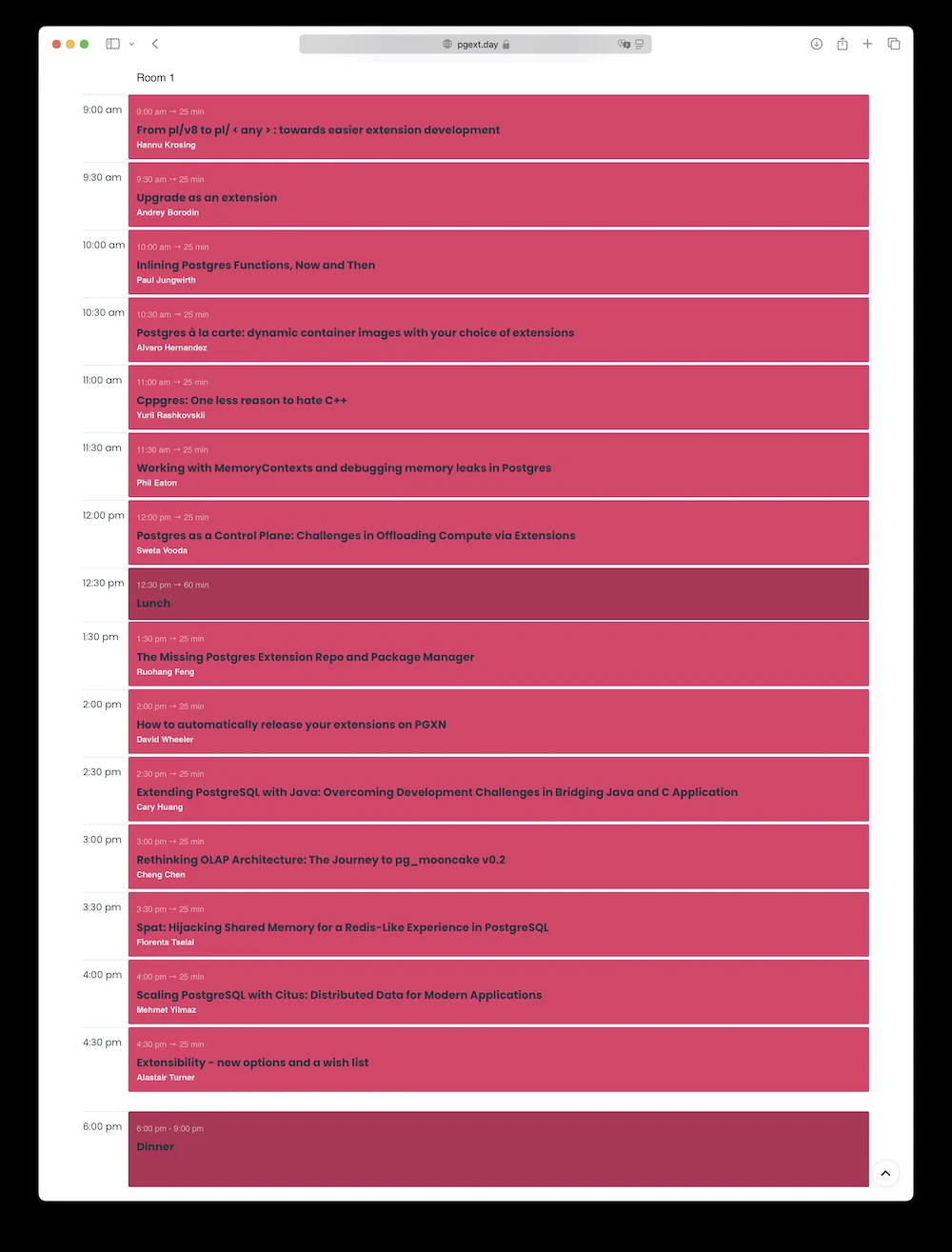
1. From pl/v8 to pl/<any>: Towards Easier Extension Development
9:00 am → 25 min, Hannu Krosing
From pl/v8 to pl/<any>: towards easier extension development
pg_tle lets developers write and deploy trusted-language extensions without superuser privileges. It also provides hooks for trusted language functions, such as enforcing password policies. pl/<any> further allows using any language to write database functions, thereby implementing extensions. The main approach is writing Language Handlers in JavaScript and using languages that can be transpiled to JavaScript as PostgreSQL’s embedded (or “pl/”) language.
Examples include:
- pl/jsonschema: Based on the AJV JSON Schema validation library, directly converting JSON Schema definitions into runnable validation functions, sometimes far outperforming pg_jsonschema wrapped with Rust + PGRX.
- pl/wasm: Runs compiled WebAssembly as standard PostgreSQL functions. For compute-intensive code, the session abstract reports execution times about 2–3 times those of native code.
- pl/codelength: Example handler that converts any source code into a function returning the original code’s length.
Future expansions on pl/v8 could include:
- Writing custom FDWs (similar to Python’s Multicorn)
- Writing custom logical decoding plugins
- Exposing more hooks and trace points for JavaScript handlers
- Allowing users to directly construct plan trees, even adding new node types or monitoring probes
2. Upgrade as an Extension
9:30 am → 25 min, Andrey Borodin
Upgrade as an extension
(No content description available, but the title alone sounds exciting!)
3. Inlining Postgres Functions: Now and Then
10:00 am → 25 min, Paul Jungwirth
Inlining Postgres Functions, Now and Then
When PostgreSQL calls user-defined functions (or built-in functions), it might attempt inlining, providing new possibilities for SQL developers and extension authors. This talk will introduce two inlining methods currently used by PostgreSQL (available now) and a patch in development aimed at supporting inlining for most set-returning functions. Your functions can replace themselves with a “plan tree,” which the optimizer then merges with other query parts - almost like writing a macro!
4. Postgres à la Carte: Dynamic Container Images with Your Choice of Extensions
10:30 am → 25 min, Alvaro Hernandez
Postgres à la carte: dynamic container images with your choice of extensions
When building Postgres container images, required extensions are typically bundled, but security and size concerns prevent packaging all hundreds of available extensions at once. However, different users need vastly different extension combinations, and building dedicated container images for every possible combination would exceed the number of atoms in the universe.
Dynamic OCI container images can be generated on demand with the required extensions. These images can be used in any OCI-compatible environment like Kubernetes.
This talk will explore the concepts and technology behind dynamic container images and how to apply them for loading arbitrary extension combinations into Postgres images. The presentation will feature extensive demonstrations!
5. Cppgres: One Less Reason to Hate C++
11:00 am → 25 min, Yurii Rashkovskii
Cppgres: One less reason to hate C++
Writing Postgres extensions in C often feels tedious, error-prone, and repetitive. While many developers avoid C++ due to its complexity, modern C++ offers rich features making it easier to write reliable, maintainable Postgres extensions.
If you’re considering switching to Rust, consider C++ first - using the same compiler while enjoying more safety and usability.
This talk will introduce Cppgres: a lightweight, header-only C++20 library for writing safer, more readable Postgres extensions. Using concepts, automatic type deduction, and other modern C++ techniques, you can write concise, efficient, maintainable extensions. The talk will show how these features apply to extension development.
6. Working with MemoryContexts and Debugging Memory Leaks in Postgres
11:30 am → 25 min, Phil Eaton
Working with MemoryContexts and debugging memory leaks in Postgres
This talk will focus on creating and switching MemoryContexts in real scenarios, using tools like Linux’s eBPF to discover memory leaks. Content is based on real production cases, summarizing experiences and practical techniques from writing extensions and finding bugs.
7. Postgres as a Control Plane: Challenges in Offloading Compute via Extensions
12:00 pm → 25 min, Sweta Vooda
Postgres as a Control Plane: Challenges in Offloading Compute via Extensions
As Postgres’s role expands from storage layer to control plane, extensions orchestrating external systems (like vector search engines) must balance performance, consistency, and integration.
This talk will explore designing Postgres extensions to offload computation while maintaining SQL simplicity and transactional guarantees. Examples from pgvector-remote cover buffering, predicate pushdown, connection pooling, and VACUUM.
The session is aimed at engineers who want to offload computation while keeping a SQL interface.
8. Lunch
12:30 pm → 60 min
9. The Missing Postgres Extension Repo and Package Manager
1:30 pm → 25 min, Ruohang Feng
The Missing Postgres Extension Repo and Package Manager
Haha, that’s really me.
While PostgreSQL extensions are powerful and flexible, most users prefer “out-of-the-box” rather than compiling and manually building themselves. I have built a repository with packages for more than 200 extensions, filling gaps in the official PGDG repository. These RPM/DEB packages cover five Linux distributions, five major PostgreSQL versions, and x86-64/ARM64 architectures.
This talk will explore building this repository, including challenges like cross-distribution compatibility, multi-architecture support, version alignment, sharing experiences, lessons, and future improvements to make PostgreSQL extension installation easier.
10. How to Automatically Release Your Extensions on PGXN
2:00 pm → 25 min, David Wheeler
How to automatically release your extensions on PGXN
There’s currently no unified release center for all PostgreSQL extensions. While PGXN is the largest extension source code release service, it only includes about one-third of public extensions, and some versions aren’t current enough.
PGXN aims to become the root registry for all extension versions, hoping to sync all release information downstream to enable automated build processes. To achieve this, developers need to proactively upload extension updates to PGXN, benefiting the entire PostgreSQL community.
This talk will demonstrate setting up release processes on PGXN and achieving automation through Git, JSON, GitHub workflows, keeping your extensions current with one-click publishing to PGXN.
11. Extending PostgreSQL with Java: Overcoming Development Challenges in Bridging Java and C Applications
2:30 pm → 25 min, Cary Huang
Extending PostgreSQL with Java: Overcoming Development Challenges in Bridging Java and C Application
Java and C have vastly different design philosophies and memory management approaches. These seemingly opposite languages can work together seamlessly with the right methods to extend C-based PostgreSQL and integrate with Java applications or libraries.
This talk will share the development journey of the SynchDB project, which writes C extensions on the PostgreSQL side and integrates Java-version Debezium Embedded, guiding data change streams from MySQL, SQL Server, Oracle, and other sources into PostgreSQL.
The talk covers the challenges of using C and Java within one extension, including:
- JNI-based cross-language calls
- The process of embedding Debezium Embedded in C extensions
- Handling memory management and performance overhead
- Architectural integration of two language components
- Best practices for error handling, monitoring, and maintainability
Attendees will learn how to bring change data from other databases into PostgreSQL and combine C and Java within one extension.
12. Rethinking OLAP Architecture: The Journey to pg_mooncake v0.2
3:00 pm → 25 min, Cheng Chen
Rethinking OLAP Architecture: The Journey to pg_mooncake v0.2
In this talk, we’ll explore shortcomings of pg_mooncake v0.1 and major architectural changes made in v0.2. We’ll share lessons learned using Postgres replication, background worker processes, and extension-form inter-process communication (IPC).
13. Spat: Hijacking Shared Memory for a Redis-Like Experience in PostgreSQL
3:30 pm → 25 min, Florents Tselai
Spat: Hijacking Shared Memory for a Redis-Like Experience in PostgreSQL
Traditional databases typically use shared memory for work areas like query execution, caching, and transaction management - invisible to users. But what if we transformed it into high-performance data structures and caches for direct user use?
This talk will introduce PostgreSQL’s shared memory APIs exposed to extension developers (including the new DSM Registry) and how to build Spat: an in-memory data structure server storing data entirely in shared memory, providing Redis-like experience within PostgreSQL.
Spat provides key-value storage patterns supporting strings, lists, sets, hashes, and other structures, becoming lightweight, high-speed temporary storage within PostgreSQL. The talk will discuss the challenges of using shared memory this way.
14. Scaling PostgreSQL with Citus: Distributed Data for Modern Applications
4:00 pm → 25 min, Mehmet Yilmaz
Scaling PostgreSQL with Citus: Distributed Data for Modern Applications
This talk will explore how the Citus extension transforms PostgreSQL into a horizontally scalable distributed database. It covers Citus architecture, extension deployment, and production use.
Content includes:
- How Citus extends PostgreSQL to support distributed query processing and data sharding
- Best practices for extension packaging, release, and deployment in different environments
- Considerations for performance tuning and security mechanisms in distributed Postgres cluster operations
- Real success cases and lessons learned
15. Extensibility - New Options and a Wish List
4:30 pm → 25 min, Alastair Turner
Extensibility - new options and a wish list
Now is a great time to be a PostgreSQL extension developer - the community continues growing, even spawning dedicated extension summit events.
Meanwhile, Postgres continues opening more extensible areas. Over the past year, several core commits made EXPLAIN, cumulative statistics, COPY, and other parts extensible, but proposals in some areas like storage still await progress.
This talk will introduce recent new extensible areas (with example code) and discuss areas that still need work, especially storage.
16. Dinner
6:00 pm – 9:00 pm
Dinner
Looking Back at PGConf.dev 2024
- Andreas Scherbaum PostgreSQL Development Conference 2024 - Review
- PgCon 2024 Developer Meeting
- Robert Haas: 2024.pgconf.dev and Growing the Community
- How engaging was PGConf.dev really?
- Cary Huang: PGConf.dev 2024:Shaping PostgreSQL’s Future in Vancouver
- PGCon.Dev Extension Ecosystem Summit Notes @ Vancouver
- PG Conference 2024 Opening, Where’s the Vancouver Foodie Travel Group?
Originally published on vonng.com.